ChatGPT, Google, and Claude Don’t Agree — Here’s What That Means for Your Business
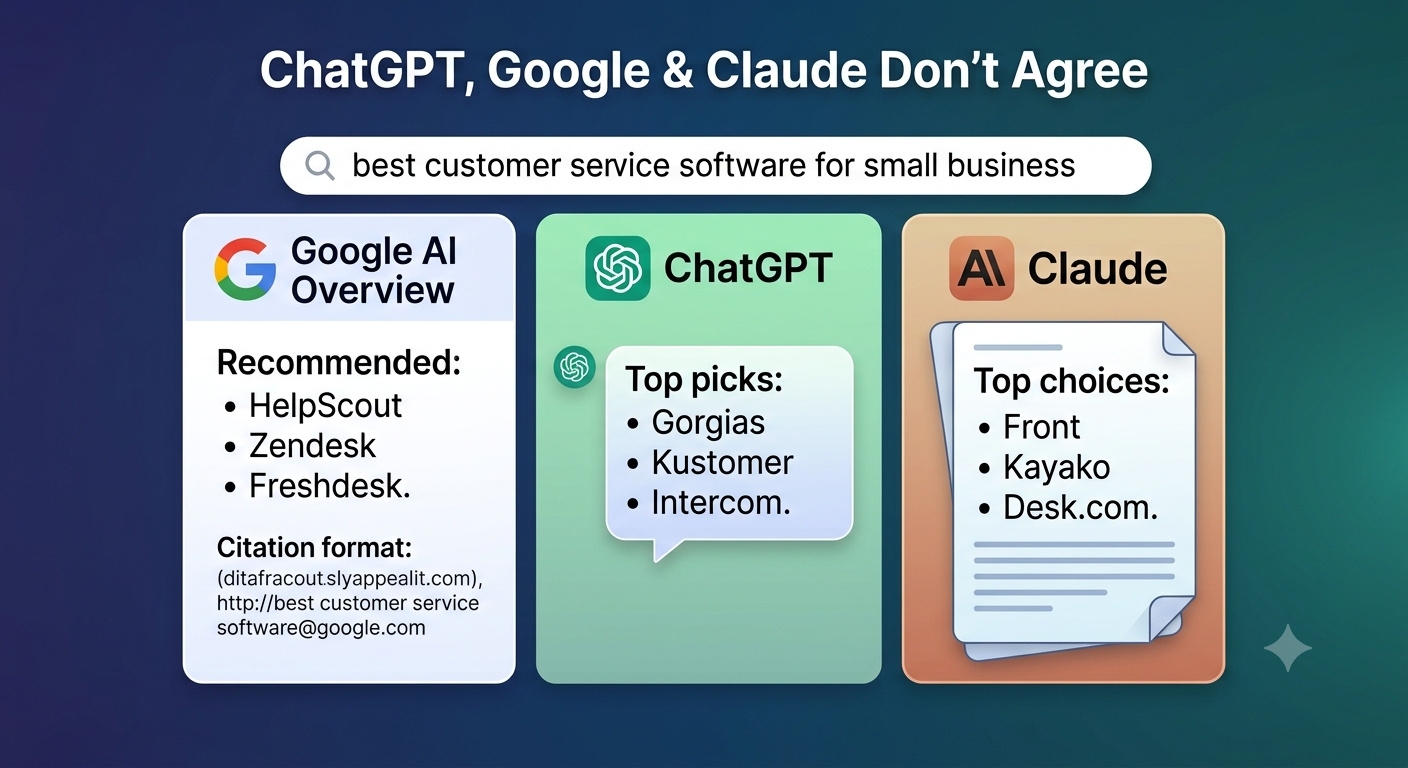
Same keyword. Same day. Three AI tools. Three completely different answers.
Here’s why that should matter to you: your customers are starting to ask AI tools which business to choose — and those tools don’t agree with each other. The same search that makes you the top recommendation in one can leave you invisible in another. I saw it happen firsthand, so let me show you exactly what I mean.
I’d been working on getting one of my clients found in AI search, and it paid off — they got cited in Google’s AI Overview for one of the most competitive, ready-to-buy keywords in their industry. The kind of keyword where the person searching is close to pulling out their wallet. A great result.
So, naturally, I got curious. I took the exact same keyword and typed it into ChatGPT and Claude to see whether they’d recommend my client too. I assumed that if Google’s AI was citing them, the others probably would as well.
They didn’t. Not even close.
The same search, three different answers
- Google AI Overview — Cited my client. Multiple times.
- ChatGPT — Recommended them too.
- Claude — Didn’t mention them once — and instead named a completely different set of brands.
Let that sink in. One business. One keyword. One moment in time. And depending on which AI a customer happened to ask, my client was either the top recommendation… or invisible. If you’d asked those three tools “who’s the best option for this?”, you’d have walked away with three different shortlists.
“Ranking in AI” isn’t one thing
This is the part most business owners haven’t clocked yet. When people say they want to “show up in AI,” they’re talking about it like it’s a single destination — like ranking on Google used to be. It isn’t. Google’s AI Overviews, ChatGPT, Claude, Gemini and Perplexity are separate systems. They pull from different sources, they trust different signals, and they update on different schedules.
Winning in one does not mean you’ve won them all. You can be the hero in Google’s AI answer and completely absent from Claude’s — for the identical question, on the identical day. There is no single “AI ranking” to chase, because there is no single AI.
My theory on why my client showed up in two but not the third
I want to be honest here: nobody can see exactly inside these models, so this is an informed theory, not gospel. But here’s what I think happened.
My client had done the boring, unglamorous groundwork — a strong presence on Google, fresh location-specific content, and mentions on other websites these tools already trust. Google’s AI Overview leans heavily on Google’s own index, so that work carried straight over. ChatGPT, when it searches the web, leans on a similar pool of well-established, widely-cited sources — so my client surfaced there too.
Claude, for that particular question, clearly pulled from a different set of sources — ones where my client simply hadn’t built a presence yet. Same business, different pool, different answer. It wasn’t that my client did anything wrong. It’s that each engine was reading from a different map.
Which leads to the single most useful takeaway from the whole experiment: the fundamentals are what got my client into two AI engines at once. Not a trick, not a hack — a strong, trustworthy footprint across the web. That’s exactly the groundwork I wrote about in my last post, and it’s worth a read if you want the how-to.
Related reading: You’re Not Using AI Wrong — You’re Using It Without Experience — why AI advice without expertise can quietly hurt your rankings, and how proper groundwork gets you cited in the first place.
What this actually means for your business
If your customers are starting to ask AI tools for recommendations — and they are — then a few things follow from all this:
- You can’t assume — Being recommended by ChatGPT tells you nothing about what Claude or Gemini says. The only way to know is to check each one yourself.
- You can’t optimise your way into one engine with a gimmick — There’s no button for “rank in AI.” The businesses that show up are the ones with genuine authority — good content, clean technical health, and mentions on trusted sites. Fundamentals win, everywhere.
- Being invisible on one engine is a real, quiet cost — Every AI tool that doesn’t know your business is a stream of ready-to-buy customers being pointed at your competitors instead — and you’ll never see it happen in your analytics.
- This is still early — Most of your competitors haven’t even noticed this shift yet. That’s the opportunity. The businesses building their AI presence now will be the default recommendations two years from now.
Try this yourself in five minutes
You don’t need any tools to see this in action. Take the main thing your business sells — the phrase a customer would actually type — and search it in three places: Google (look for the AI Overview at the top), ChatGPT, and Claude. Then compare. Are you mentioned? In all three, or just one? Who shows up instead of you?
Most business owners who do this are genuinely surprised. Either they’re missing from answers they assumed they owned, or a competitor they’ve never worried about is being handed to customers on a plate. Either way, now you know — and knowing is the first step to fixing it.
The bottom line
Search isn’t one doorway anymore. It’s a dozen, and they don’t all point to the same place. The good news is that the way in hasn’t changed as much as it looks: build a real, trustworthy presence across the web, and you give yourself the best shot at showing up no matter which engine your customer asks. Chase gimmicks for one engine, and you’ll lose the others.
Curious where your business actually stands across Google, ChatGPT and Claude? That’s exactly the kind of thing I dig into on a free 30-minute call. Get in touch and I’ll tell you, in plain language, where you’re showing up, where you’re invisible, and what it would take to fix it.
Over to you
Have you searched your own business across different AI tools? Did they agree — or give you three different answers like mine did? And why do you think one AI recommends a brand while another ignores it entirely: different sources, freshness, trust signals, something else? I’d genuinely love to hear what you’re seeing.