Word of mouth built most small businesses. A happy customer tells a friend, the friend calls you, and the cycle continues. That still happens, and for some businesses it’s still the main source of new work.
But think about how you find a plumber, a dentist, or a new lunch spot today. You search on Google. So do your future customers.
Word of mouth has a ceiling. It only reaches people who already know someone who knows you. A person who just moved to town, someone searching at 10 p.m., or someone comparing three options before they call isn’t hearing about you from a friend. They’re searching. If you don’t show up, your competitor does.
That’s where SEO for small business comes in.
What is SEO for small businesses?
SEO (search engine optimization) is the work of making your website easy for search engines to find, understand, and trust, so it shows up when people search for what you offer.
For a small business, that usually means showing up for searches like:
- “[your service] near me”
- “[your service] in [your city]”
- “best [your service] for [specific need]”
- The questions your customers ask before they buy
The goal isn’t just traffic. It’s getting in front of the right people at the moment they’re ready to choose someone.
Why SEO is important for small businesses
Your online presence is for the future, not just today
When you build an online presence, you’re not building it for this week’s sales. You’re building an asset that keeps working.
Paid ads stop the moment you stop paying. SEO is different. A page that ranks well can keep bringing in visitors for months or even years after you create it.
SEO builds trust, and trust compounds
SEO traffic isn’t a one-time event. When people find your site, stay, and get what they need, Google starts to trust your website more. As that trust grows, Google shows your site for more searches, including ones you never specifically targeted. One ranking page helps the next one rank. Over time, your whole site gets stronger.
You compete where your customers already are
Your competitors are online. If they show up and you don’t, they get the call. SEO gives small businesses a fair shot against bigger companies, especially in local searches, where being close and relevant matters more than having a big budget.
Is SEO worth it for small businesses?
For most small businesses, yes, as long as you treat it as a long-term investment and not a quick fix.
SEO is worth it if:
- Your customers search online before they buy (most do)
- You want a steady flow of new customers, not only referrals
- You can commit to it for at least 6 to 12 months
- You serve a defined area or niche you can realistically compete in
SEO vs. paid ads: which should a small business use?
It’s not always one or the other.
Paid ads (like Google Ads) put you at the top of results right away. They’re useful for a launch, a seasonal promotion, or when you need leads this month. But the traffic stops as soon as your budget does.
SEO is slower to start, but the results build on each other and keep working without paying for every click.
Many small businesses run ads while SEO is building, then lean more on organic traffic as rankings grow.
How long does SEO take for a small business?
This is the question every business owner asks. The honest answer: it depends.
What the climb usually looks like
When you start SEO on a new website, you usually won’t show up on Google at all. That’s normal.
As you work on the site, publish useful content, and fix technical issues, you’ll start to appear, often somewhere around positions 70 or 80. It doesn’t feel like much, but it means Google has noticed you and is testing where you belong.
With steady work, you climb. Page 5, page 3, page 2, and eventually page one.
Most small businesses start seeing meaningful movement within 3 to 6 months, and stronger results over 6 to 12 months. Brand-new websites can take longer. Google’s John Mueller has said it can take up to a year for Google to figure out where to rank a new site.
What affects how fast your site can rank
Every business is different. Your timeline depends on factors like:
- Your starting point. Is this your first time doing SEO, or does your site already rank for a few keywords? If you already have some online presence, we’re not starting from zero. Pages sitting on page 2 or 3 can often be pushed up much faster than a brand-new page.
- Your competition. A local bakery in a small town will usually move faster than a law firm in a major city. If big national brands or well-established local businesses own the top spots, it takes more work to catch up.
- What the search results look like. Some keywords show local map results, some show guides, some show service pages. The type of results Google shows affects what kind of page you need and how quickly it can compete.
- How much work goes into the site. The more hours spent on content, technical fixes, and authority building, especially early on, the faster things move.
- Your keyword choices. Niche and local keywords often rank in weeks or a few months. Broad, competitive keywords can take a year or more.
So one business might see results in 1 month, another in 3 months, and another might need 12. The only way to know is to look at your site and your market.
Want to know how long it will take for your business?
Book a free 30-minute call with me. I’ll go through your website and your current data, then give you real numbers instead of guesses:
- How long it’s likely to take your site to rank
- The niche keywords worth focusing on for your business
- The local keywords your customers are searching for in your area
- How long each of those keywords may take to rank, based on your competition
No pressure and no jargon, just a clear picture of where you stand and what it will take.
SEO is ongoing: work hard early, then maintain
SEO isn’t a one-and-done project. It happens in stages.
Stage 1: Work aggressively at the start
When your site is new, or new to SEO, this is when to put in the most effort. Publish pages, update content, fix technical issues, and add new information regularly.
Every time you update your site, you give Google’s crawler a reason to come back. The more often it visits and finds fresh, useful content, the sooner Google recognizes that a real, active business has arrived and starts giving your site more attention.
Stage 2: Climb toward page one
This stage is about consistency: more helpful pages, better answers to customer questions, and a site that loads fast and works well on phones.
Stage 3: Maintain your position and build authority
Once you’re on page one, or in the top 5 positions, the pace changes. You don’t need to work as aggressively, but you can’t stop. Your competitors keep working too.
Focus on:
- Keeping content fresh. Update pages when your services, prices, or details change.
- Building domain authority. The stronger your site’s overall reputation, the easier it is for new pages to rank.
- Earning backlinks. Links from trusted websites (local news, industry associations, partners, directories) show Google that others vouch for you.
How to do SEO for a small business: the basics
1. Set up your free tools
- Google Business Profile: claim and complete it with your name, address, phone, hours, services, and photos.
- Google Search Console: see which searches bring people to your site and catch technical errors.
- Google Analytics: track how many visitors come from search and whether they become calls, bookings, or sales.
2. Build clear service pages first
Before you start a blog, make sure every core service has its own focused page. A plumber should have separate pages for drain cleaning, water heaters, and emergency repairs, not one page that lists everything. Clear service pages are what most small business searches land on.
3. Check what searchers actually want
Before you create or redesign a page, search your target keyword and study the results.
If you search “SEO for small business” or “SEO optimization for small business,” what shows up? Guides? Service pages? Pricing? Videos? Questions in People Also Ask?
The results show you what Google thinks searchers want. If page one is full of step-by-step guides, a sales page alone probably won’t rank. If it’s full of local businesses on a map, you need a strong local presence. Use what you find to shape your page’s content, structure, and design. Match what people are looking for, then do it better.
4. Optimize each page
- Write a unique title tag for every page, like “Plumber in Ottawa | Fast Fix Plumbing.”
- Add a clear meta description that tells searchers why to click.
- Use one H1 heading per page that matches what people search for, and H2s for subtopics and questions.
- Write for people first. Answer real questions clearly instead of repeating keywords.
5. Fix the technical basics
- Make sure your site works well on mobile. Google looks at the mobile version of your site first.
- Keep pages fast by compressing large images.
- Use HTTPS (an SSL certificate) so your site is secure.
- Link your pages together so visitors and Google can move through your site easily.
Local SEO for small business
If you serve customers in a specific area, local SEO is likely your biggest opportunity. It helps you appear in map results and “near me” searches, where people are often ready to call or visit.
Local SEO basics:
- Complete your Google Business Profile and post updates regularly.
- Keep your NAP consistent. Your business name, address, and phone number should match exactly on your website, social media, and directories.
- Use location keywords in your headings and page content, like your city or neighbourhood.
- Ask happy customers for Google reviews and reply to every one.
- Create location pages if you serve more than one area.
- Get listed in relevant local directories.
Want help showing up in your area? Learn more about our local SEO services.
We help local businesses get found
We’ve worked with many local businesses to help them rank on Google and bring in more customers from search. Our clients include cleaning companies, chiropractors, healthcare clinics, and other local service businesses that rely on people in their area finding them at the right moment.
Every one of them started with the same questions you might have right now: Where do we stand? What should we focus on first? How long will it take? We answered those questions with their real data, built a plan around their market and competition, and kept working on it month after month.
Want to see what that looks like in practice? Visit our client success stories to read how we’ve helped businesses like yours grow their online presence.
Have questions about your own business? Book a free 30-minute call with us. We’ll look at your site, answer your questions, and give you an honest picture of what SEO can do for you.
SEO in the age of AI search
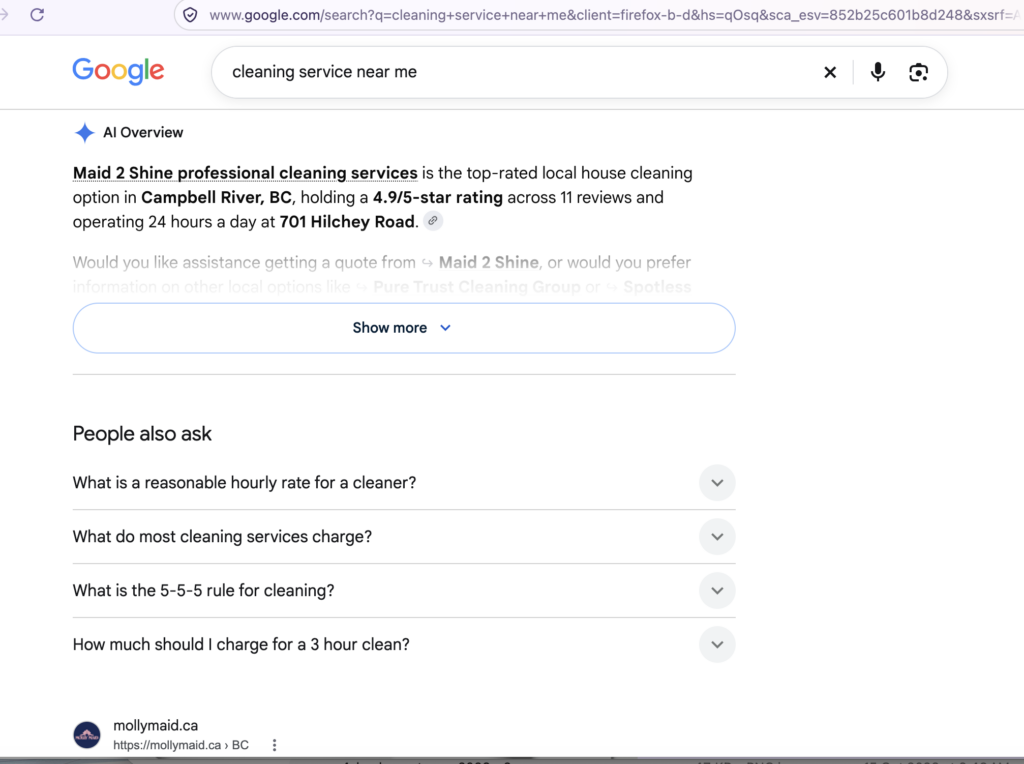
Search is changing. Google now shows AI Overviews at the top of many results, and more people ask tools like ChatGPT for recommendations.
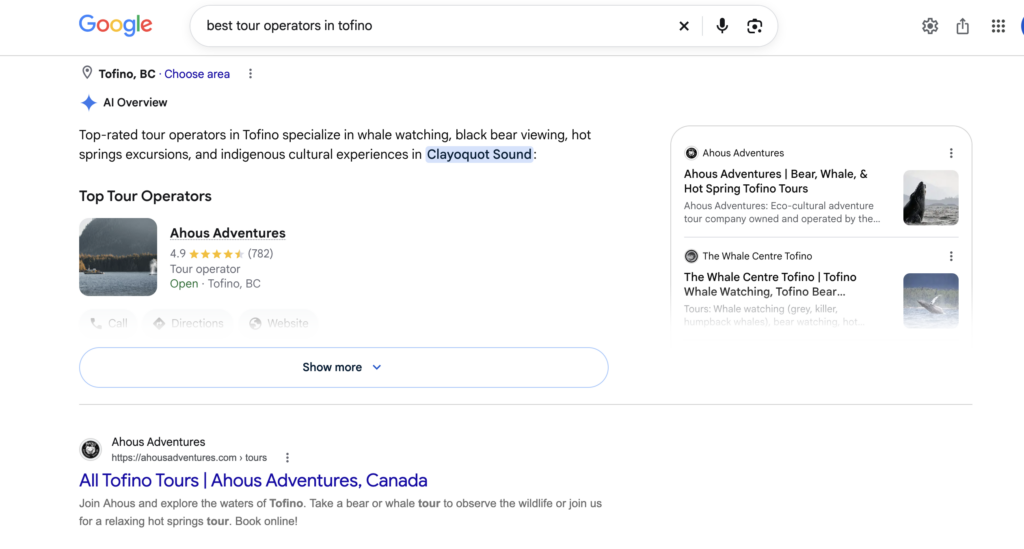
The good news: what helps you rank in Google also helps you appear in AI answers. Clear content that answers real questions, a trustworthy site, and mentions across the web all make it more likely AI tools will reference your business.
This is often called generative engine optimization (GEO) or answer engine optimization (AEO). See how we help businesses get found in AI search on our AI search optimization page.
Common SEO mistakes small business owners make
- Giving up too early. Most businesses quit just before results start to show.
- Putting every service on one page. Each service deserves its own page.
- Stuffing keywords. It reads badly and doesn’t help rankings.
- Inconsistent business details across directories and social profiles.
- Ignoring mobile users. Most local searches happen on phones.
- Buying cheap backlinks. Low-quality links can hurt more than help.
- Only tracking rankings. Rankings matter, but calls, form fills, and bookings are what pay the bills.
Can you do SEO for free?
Many SEO basics cost nothing but time: your Google Business Profile, Search Console, Analytics, asking for reviews, and writing helpful content. A small business owner can make real progress on these alone.
As competition grows, technical fixes, content strategy, and link building take more time and experience. That’s usually when it makes sense to bring in help.
How much does SEO cost for a small business?
SEO costs depend on your industry, location, competition, and goals. Doing it yourself is free apart from your time. Hiring a specialist or agency in Canada typically ranges from about $500 to $2,500 or more per month, with competitive industries and multi-location businesses on the higher end.
Be careful with very cheap packages and anyone who guarantees a #1 ranking. Look for a partner who explains what they’ll do, sets honest timelines, and reports on leads, not just rankings.
Explore our SEO services to see how we help small businesses grow.
Start building your online presence today
Word of mouth will always matter. But the businesses that grow steadily can also be found by people who’ve never heard of them.
SEO takes time, and the best time to start is before you need it. Work hard early, climb steadily, then maintain and build authority. The results compound.
Ready to get found? Book a free 30-minute call with us, or check out our client success stories to see how we’ve helped local businesses grow.
Frequently asked questions