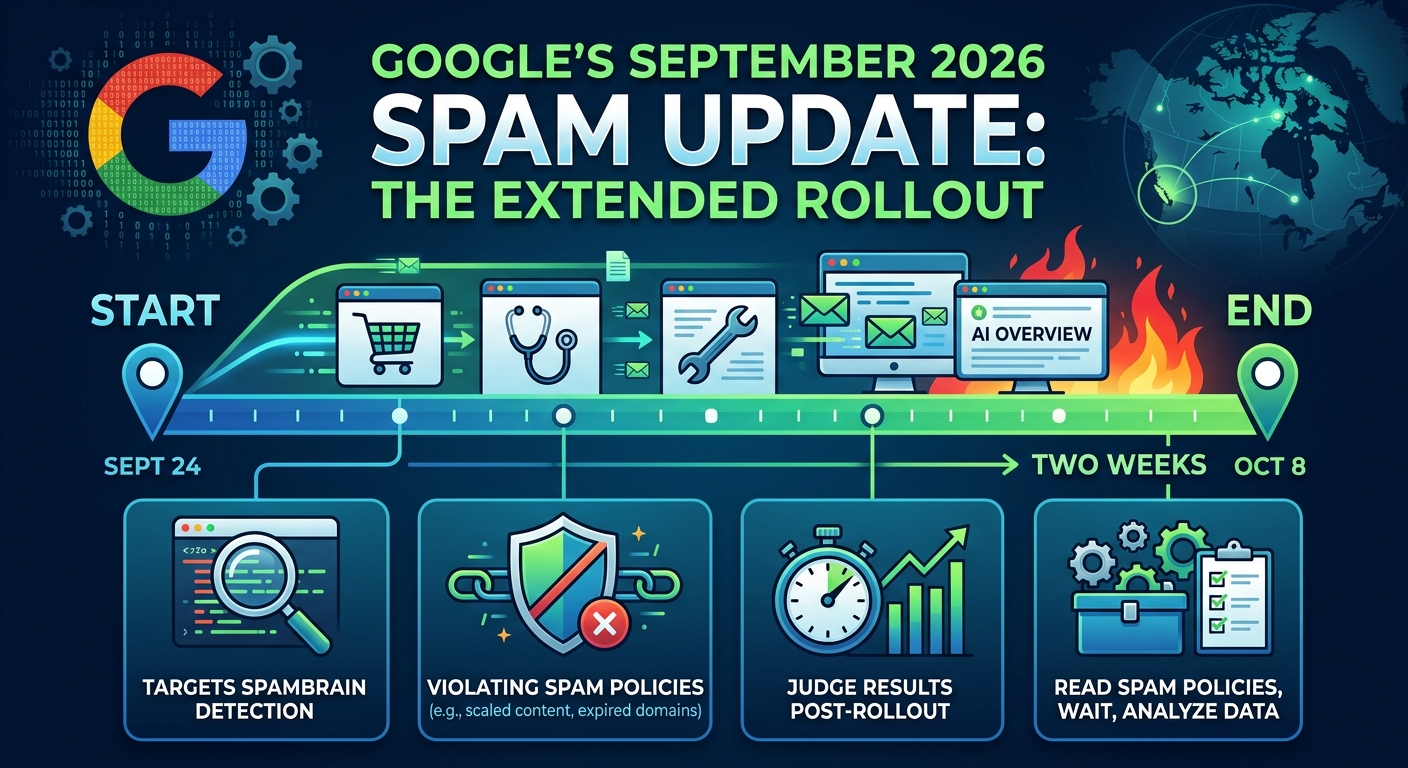
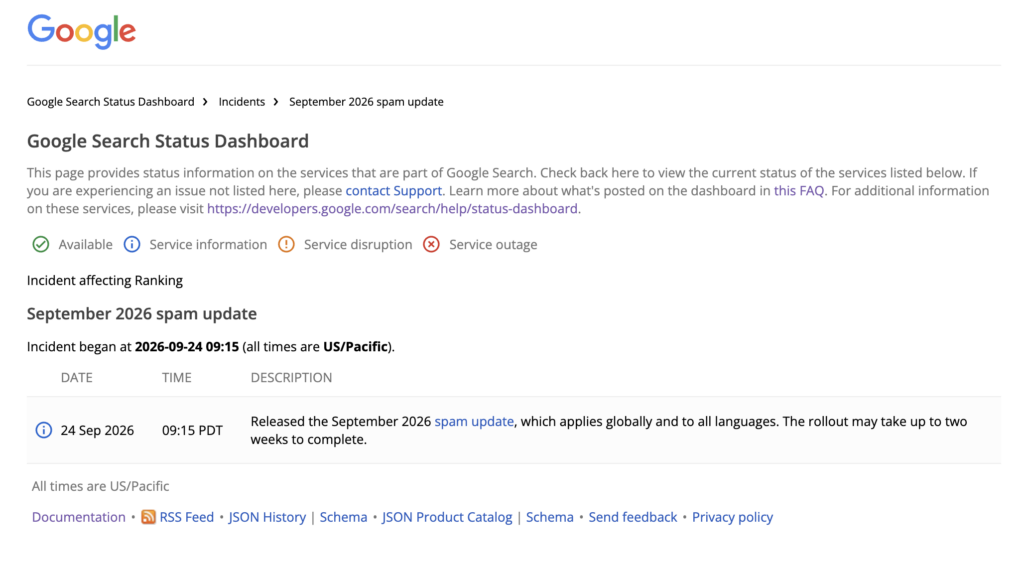
Google started rolling out the September 2026 spam update on September 24 at 9:15 a.m. PDT. It applies globally and to every language.
The detail worth paying attention to is not the update itself. It is the timeline.
Google says this rollout may take up to two weeks to complete. Previous spam updates this year finished in under three days.
What Google actually said
The announcement on the Google Search Status Dashboard was two sentences:
“Released the September 2026 spam update, which applies globally and to all languages. The rollout may take up to two weeks to complete.”
That is the whole announcement. No detail on what it targets, no named policy, no indication of scale. That is the whole announcement. No detail on what it targets, no named policy, no indication of scale.
Why the two-week window is unusual
Here is how Google’s 2026 updates have actually rolled out, according to Google’s own ranking updates history:
Update | Type | Rollout time |
March 2026 core update | Core | 12 days, 4 hours |
May 2026 core update | Core | 11 days, 21 hours |
June 2026 spam update | Spam | 2 days, 1 hour |
August 2026 spam update | Spam | 2 days, 16 hours |
September 2026 spam update | Spam | Up to 2 weeks (stated) |
Look at the pattern. Spam updates this year took two to three days. Core updates took eleven to twelve.
Google has given this spam update a rollout window that looks nothing like a spam update and everything like a core update.
Google’s John Mueller confirmed the two-week figure was not a mistake, saying it is “likely to take longer than some of the previous ones.”
Longer rollouts usually mean one of two things. Either a broader change is being applied more carefully, or it is staged, hitting different categories of site at different points. Either way, it changes how you should read your own data.
If your rankings move on day three, that is not the full picture. Judge nothing until Google confirms the rollout is complete.
What a spam update actually targets
A spam update is an improvement to the automated systems Google uses to detect search spam, SpamBrain being the main one. It is not a core update, and it is not about content quality in the broad sense.
It targets sites violating Google’s spam policies. Cloaking, doorway pages, scraped content, keyword stuffing, hacked content, expired domain abuse, scaled content abuse, site reputation abuse.
Google has not said which of those this update focuses on, and has not indicated it targets link spam specifically.
One thing worth knowing from Google’s documentation. If you are hit by a spam update and you fix the problem, recovery is not fast. Google says its systems need to learn “over a period of months” that your site complies.
With link spam updates specifically, fixing things may not help at all. Once the system discounts the spammy links, whatever ranking benefit they provided is gone permanently. You do not get it back.
About the volatility on September 23 and 24
A lot of people saw significant ranking movement in the two days before the announcement and assumed the spam update had arrived early.
It had not. Google confirmed the pre-announcement volatility was separate. Two core updates have already shipped in 2026, and another is widely expected, so some of what people are seeing is likely unrelated to spam at all.
This matters for diagnosis. If your traffic moved on the 23rd, the spam update is not your explanation.
What we are watching across our client sites
We manage SEO services across e-commerce, healthcare, construction, powersports and local service businesses, and we are tracking all of them through this rollout.
Where those accounts stand going in:
- An e-commerce site at 94,777 users year to date, 34,117 of them from organic search
- A healthcare practice generating 362 qualified conversions this year, 66% of them from organic
- An established site at 937,000 impressions with an average position of 22.1
- A service business holding an average position of 3.2 at a 14.4% CTR
- One client now appearing in AI Overviews, at 18,000 impressions since Google’s Generative AI report launched in May
None of these sites use tactics that put them at risk under a spam update. That is exactly why they are worth watching. Clean sites getting caught is how you spot collateral damage, and collateral damage happens with every update regardless of what Google intends.
We will publish a follow-up once the rollout completes, with the actual before and after data. Not predictions. Numbers.
What to do right now
Take a baseline today. Export your Search Console performance data for the last 28 days before the rollout overwrites your comparison window. You cannot go back and get this later.
Annotate September 24 in GA4 and Search Console. In three months you will not remember which dip belonged to which update.
Read the spam policies properly. Not a summary, the actual policy page. Most site owners who get hit are violating something they did not know was a violation, usually around scaled content or expired domains.
Then wait. Two weeks minimum before you conclude anything.
What not to do
Do not make sweeping changes mid-rollout. If you rewrite half your site during a two-week rollout, you will never know which change caused which outcome, and you will have destroyed your own ability to diagnose the problem.
Do not disavow links in a panic. This update has not been identified as a link spam update.
Do not buy a recovery service from anyone promising to fix it this month. Google has stated plainly that recovery takes months. Anyone claiming otherwise is selling something that does not exist.
We will keep you posted
We will update this post as the rollout progresses, and publish a full analysis with client data once Google confirms completion.
If your traffic has moved and you are not sure whether it is this update, a core update, or something on your own site, send us your site and we will take a look.